


Beyond the Genetic Code
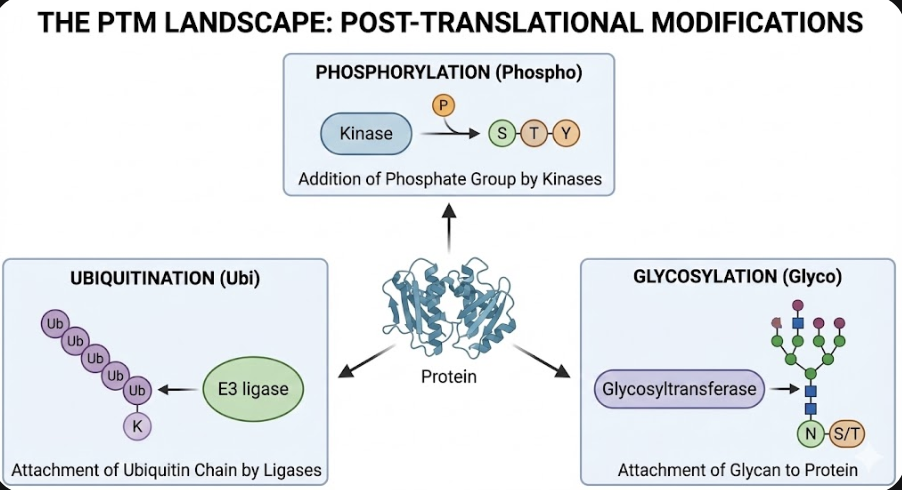
While the genome provides the blueprint, Post-Translational Modifications (PTMs) dictate the functional state of the cell. PTMs regulate everything from signal transduction and gene expression to protein stability and localization.
Because most modifications are sub-stoichiometric (existing on only a small fraction of the total protein), standard proteomics often misses them. We utilize specialized enrichment strategies to isolate these modified peptides from the complex background.
Facility Benchmarking: The Power of Enrichment
Robotic SP3 vs. Manual Prep
We recently validated our KingFisher SP3 automated workflow against traditional manual methods using mouse liver lysates. The results confirm that automation significantly enhances consistency and sensitivity.
- Phospho-Enrichment Success: Without enrichment, we identified ~700 phospho-sites. With our KingFisher enrichment protocol (300µg input), we identified 9,220 phospho-sites in a single run.
- Low Input Sensitivity: At 1µg input levels, manual preparation yielded inconsistent results (0–300 proteins). The KingFisher robot consistently identified ~2,900 proteins from the same 1µg input on the timsTOF HT.
"Proteins essentially precipitate on the beads allowing removal of detergents and salts... increasing sensitivity by reducing sample handling." — Internal Validation Report, 2023

Data generated from 300µg mouse liver peptide input.
Supported Modifications
Phosphorylation (Phospho)
Residues: Ser, Thr, Tyr, His
We use TiO2 and Fe-NTA (IMAC) for global enrichment. For specific tyrosine signaling, we employ SH2-domain affinity reagents.
Ubiquitination (Ubi)
Residues: Lys (K)
We enrich for the specific diglycyl-lysine (K-ε-GG) remnant using the anti-K-ε-GG antibody to identify exact modification sites.
Glycosylation (Glyco)
N-linked: Asn | O-linked: Ser/Thr
We utilize HILIC and Lectin-based strategies to enrich hydrophilic glycopeptides.
Additional Modifications
- Acetylation: Regulates histone function.
- Methylation: Epigenetic marker.
- Oxidation: Indicator of oxidative stress.
- O-GlcNAc: Enriched via specific antibodies.

Critical Sample Preparation Guidelines
Successful PTM analysis begins at the bench. Based on our internal data, we require the following conditions:
- Inhibitors are Mandatory: Cell lysates must be prepared with broad-spectrum phosphatase and/or deubiquitinase inhibitors.
- High Input Material: For robust Phospho-enrichment, we recommend starting with at least 200–300µg of peptide.
- Protein Starting Amount: Assuming a 50% yield from digestion, this means you should start with at least 600–700µg of total protein per sample.
- Avoid Milk: Do not use milk for Western Blot blocking (casein interference).
Project Consultation
Because PTM enrichment is chemically specific, we highly recommend a consultation before you begin sample collection.
Schedule a Design Meeting →References & Further Reading
For a comprehensive overview of Bottom-Up Proteomics and PTM strategies, we recommend the Meyer Lab Proteomics Tutorial:
Jiang Y, Rex DAB, Schuster D, et al. (2024). Comprehensive Overview of Bottom-Up Proteomics using Mass Spectrometry.
Available at: https://jessegmeyerlab.github.io/proteomics-tutorial/